


The African diaspora: an overlooked financial powerhouse that exceeds international aid

Aktualisiert: 2. März
Lire la version française ici.
Every year, far from diplomatic summits and official announcements, a financial force continuously nourishes Africa, as discreetly as it is massive: money transfers from its diaspora. The Barometer on Remittances to Africa by its Diaspora1 , produced by The Seeds, lifts the veil on these substantial cash flows, with nearly $100 billion sent to the continent in 2023, or about 4% of Africa's GDP.
These are colossal sums, exceeding official development assistance and foreign direct investment combined.
Behind these figures are millions of individual acts of solidarity that paint a major macroeconomic picture: the African diaspora is now one of the continent's leading financial backers, without institutional recognition commensurate with its real weight.
"A financial windfall of historic proportions"
The barometer reveals an impressive trend: remittances have increased sevenfold in twenty years, and even tenfold for sub-Saharan Africa.
On an individual level, each member of the diaspora surveyed sends an average of more than €4,000 per year (Figure 1), with more than eight transfers per year ( Figure 2), mainly to their country of origin (98% of flows).
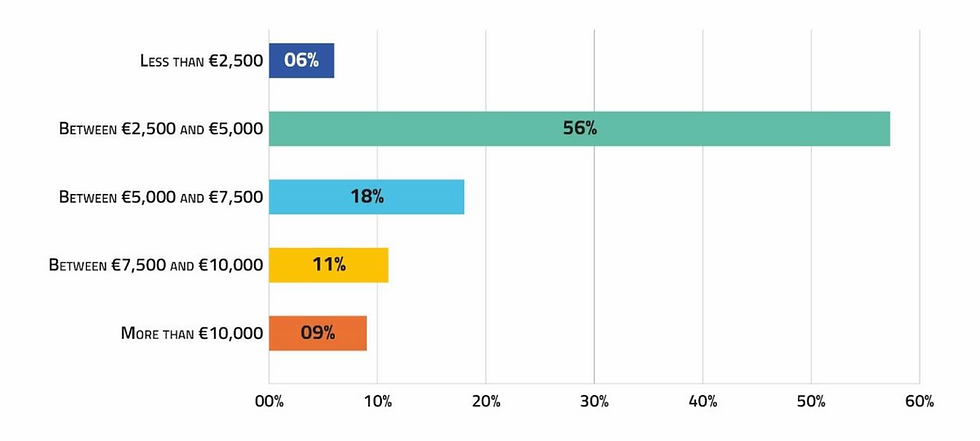
Figure 1 : Average annual amount transferred between 2022 and 2024

Figure 2 : Average annual frequency of transfers between 2022 and 2024
When viewed in relation to the continent, this annual flow of $85 billion represents a financial power comparable to a major international reconstruction plan... renewed every year for more than 10 years
"Comparison with the Marshall Plan for the reconstruction of post-war Europe"
Between 1948 and 1952, the United States deployed approximately $13 billion to rebuild Western Europe after World War II2 . Adjusted to its current value, this sum would be equivalent to approximately $150 billion today, spread over four years, or $37.5 billion per year
In other words:
Each year, the African diaspora transfers more than twice the amount of the "Marshall Plan" to Africa.
And it does so without a central state, without multilateral institutions, and without a coordinated strategy.
These cumulative transfers from the African diaspora far exceed the financial effort that enabled the reconstruction of Europe, the modernization of its infrastructure, and the revival of its economies after World War II.
"A diffuse but poorly directed financial force"
The study shows that this financial power is used much more for survival and to meet daily needs than for structural transformation (Figure 3).
85% of the funds directly benefit family and relatives.
51% is used to cover basic essential needs: food, housing, health, education;
19% is spent on real estate (purchasing or renovating property);
11% goes towards savings or investment;
and only 7% is spent on community projects.

Figure 3 : Main recipients of remittances
The diaspora thus plays a fundamental role as an informal social safety net, compensating for the shortcomings of public systems.
But this logic of assistance, however vital it may be, limits the transformative impact of these flows. Nearly 45% of senders believe that their transfers do not improve the autonomy of recipients
"Another illuminating comparison: the Chinese Development Plan"
Another parallel helps to measure this untapped potential: China's overseas investment policy, particularly through the Belt and Road Initiative.
Since 2013, China has mobilized approximately $1 trillion in loans, investments, and infrastructure financing in more than 140 countries. This massive plan is based in particular on:
A centralized strategic vision,
Clear allocation of funds to infrastructure projects (ports, roads, energy),
And close coordination between finance, diplomacy, and economic development.
With an average of $85 billion sent each year, the African diaspora has mobilized and deployed to Africa since 2013 a sum equivalent to all of China's commitments under the New Silk Roads program, but in a fragmented, uncoordinated manner and without political, institutional, or economic leverage.
"A diaspora with impressive striking power, but under-mobilized."
The paradox is all the more striking given that the diaspora studied is (Figure 4 and Figure 5):
Highly qualified (more than 70% have a master's degree or higher),
Professionally integrated (80% are employees or entrepreneurs),
And permanently settled in their countries of residence

Figure 4 : Distribution of the sample by level of education

Figure 5 : Distribution of the sample by professional status
It therefore has not only financial resources, but also skills, networks, and considerable economic engineering capacity. However, due to a lack of trusted frameworks, guarantees, and appropriate mechanisms, this strength remains largely confined to the private and family spheres.
"From solidarity to transformation: a possible historic turning point"
The study highlights a key question: how can a continuous and massive financial flow be transformed into a real lever for development?
History shows that money alone is not enough. The Marshall Plan was not just a check: it came with conditions, coordination, governance, and specific industrial objectives. Similarly, successful large-scale development plans rely on structuring flows, partially pooling them, and directing them toward productive investments.
The African diaspora already represents the continent's sixth economic region, recognized as such by the African Union. But the tools capable of transforming this diffuse power into a structuring force have yet to be invented.
"A silent power at a crossroad"
Every transfer sent is an act of love and responsibility. Taken individually, it provides relief. Taken collectively, it could transform.
Given the amounts involved, the question is no longer whether the diaspora can contribute to Africa's development. It already does so, on a massive scale. The real question now is political, institutional, and strategic: how can we move from an "invisible Marshall Plan" to a collective project that is fully embraced?
The barometer thus acts as a revealing indicator. Behind the figures, it highlights an obvious fact: Africa possesses, outside its borders, one of the greatest financial powers in its history, but one that seems to lack transformative direction.
It is precisely to this collective effort to define transformative directions that The Seeds will devote its Think Tank on March 14, 2026, in Hamburg. You are welcome to attend. We look forward to seeing many of you there so that together we can find solutions that will enable this financial power to become a real engine of development. REGISTER directly on our website www.the-seeds.net
The full publication is available here:
Until next time,
[1] The African diaspora: an overlooked financial powerhouse that exceeds international aid. February18th, 2026

